Explore space, light and play
Discover how art, materials and scenography can transform learning spaces. For educators, teachers, designers and arts professionals.
Your access lasts 10 weeks
You have 10 weeks of access from your start date. You can work at your own pace within this period. At the end of the 10 weeks, access to the content and discussion area closes automatically, even if some lessons remain unfinished.
Check your expiry date in the campus and plan your learning before that date. Each meeting notice will state how long its recording is available.
Certificate of participation: requirements
At the end of your enrolment period, we will issue a certificate of participation once the team has checked these requirements:
- Complete at least 80% of the content. After working through each lesson, click “Complete” or “Complete lesson” and check that your progress is recorded. Opening a lesson or watching a video does not automatically mark the lesson as completed.
- Participate in the two online sessions corresponding to your enrolment. If you cannot attend one or both sessions, you will receive a recording link by email. After watching it, reply to the email containing the link with comments, reflections or a related task that demonstrates your participation. Do this for each session you miss; receiving or opening the link does not demonstrate participation.
Complete your course work and send your responses within your enrolment period. Participation is reviewed using lessons recorded as completed, the required activities, and attendance at the sessions or the corresponding responses.
A commitment to honesty. By marking a lesson as completed, you confirm in good faith that you have worked through its content. We trust each participant’s commitment. The campus percentage records declared progress; it does not automatically verify viewing. A lesson’s estimated duration or the time it stays open does not by itself prove time spent studying. When reviewing your certificate, we may ask for a short confirmation by email; a signed declaration is not required for Createctura’s ordinary participation certificate.
The certificate will be issued at the end of your enrolment, after review by the team.
How to record and check your progress
- Sign in to the Campus, open “Mis cursos” (my courses), and select your course.
- After working through a lesson, click “Complete” / “Completar” at the end of its content. If you have already studied a lesson but forgot this step, you can return and mark it as completed during your access period.
- On the course page, look for “Progreso del curso” (course progress) in the course information panel. On mobile, it may appear below the description. From a lesson, use “Volver al curso” or the course title to return to this page.
This percentage reflects elements recorded as completed; opening a page or playing a video does not automatically increase it. “Resultado” or “Progreso de calificaciones de aprobación” may depend on quizzes and your edition’s assessment criteria: they are different from content progress and the certificate review.
If the percentage does not update, reload the course page. If it still does not save, email your course contact with your name and the lesson title. Never share your password.
Questions and practice: where to participate
Email. Write to formacion@createctura.es for individual course questions, private matters or access difficulties. Include your name, course and the lesson or topic concerned.
Campus forum. Open Consultas y prácticas on this course page to ask questions about the content, share a practice and read replies. Start your message with the topic or lesson and explain your question or practice. Press Publicar consulta. To continue a conversation, use Responder in the same thread. You can attach one JPG or PNG photo up to 3 MB. Posts are visible to authorised participants in the same course and the teaching team during your access period.
Canva for meetings. Use your course’s collaborative Canva presentation to share images, observations and questions about your practice for discussion in the Zoom meetings. The link is provided by email. Label your contribution with your name and prepare it before the meeting. If you cannot access Canva or prefer to share privately, email your contribution to the team and say that it is for the meeting.
Canva supports discussion. Submit individual assignments and assessments through the channels specified by your course.
- In English
- 10 weeks of access
- €85
- 2 live online sessions
Access lasts 10 weeks from your start date. Live sessions in English begin on 2 November 2026; there is no October meeting.
🕒 Format and schedule
Flexible access to all course content at any time throughout the course.
Your enrolment includes two live online group sessions. Sessions take place on the FIRST MONDAY OF EACH MONTH, FROM 7:00 PM TO 8:30 PM (mainland Spain time, Europe/Madrid). Live sessions in English start on Monday, 2 November 2026. There is no live session in October.
- Monday, 2 November 2026
- Monday, 7 December 2026
If you are unable to attend, you may send your questions in advance.
The sessions are recorded, and the recordings are sent to participants who are unable to attend live.
✨ Inhabited Scenographies
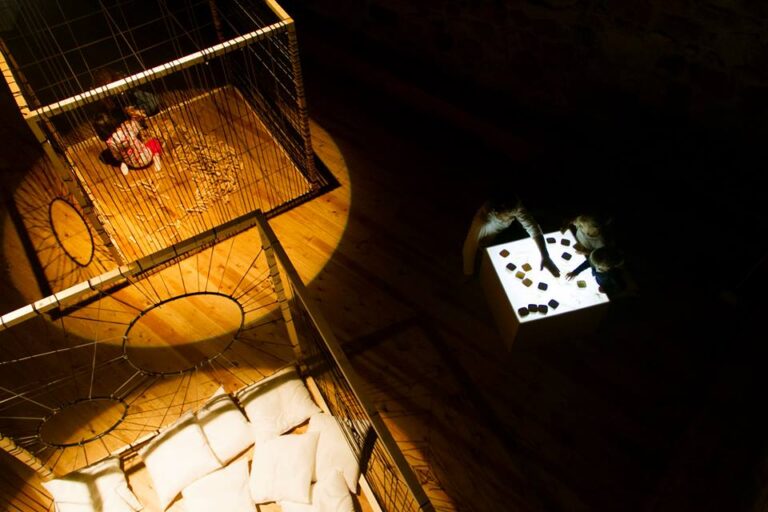
Inhabited Scenographies are a pedagogical strategy developed by Createctura over more than a decade of work. They propose transforming educational spaces into living, responsive environments that embrace diversity.
In contrast to the rigidity of traditional school models, this approach is based on designing flexible, open and multifaceted learning environments capable of supporting different learning pathways simultaneously. Through scenography—inspired by both contemporary art and theatre design—we create inhabitable multiverses that foster autonomy, curiosity, imagination and play as drivers of learning.
This training begins with a deep reflection on the origins of today’s education system, its obsolescence and the urgent need to create inclusive environments that recognise difference not as an exception, but as a starting point.
The course combines conceptual, technical and practical content with access to real experiences developed in schools, cultural centres and community spaces. It is intended for teachers, designers, architects and professionals in education and the arts who wish to broaden their perspective on pedagogical design.
📚 Contents
- Foundations of the approach: diversity, flexibility, aesthetics and complexity.
- Scenography as an educational tool for transforming the environment.
- Light and sound as sensory materials in pedagogical design.
- Real projects: theatres, schools, festivals and cultural centres.
🎯 Objectives
- Rethink space as a pedagogical driver from a creative perspective.
- Design inclusive, aesthetic and adaptable environments using simple resources.
- Explore scenographic tools for creating immersive experiences.
- Discover visual, sonic and performative references for the classroom.
📌 Further information
You can view the full syllabus in the Curriculum tab. Some platform controls are currently displayed in Spanish. For help with enrolment, see our enrolment guide in English.
Consultas y prácticas de la edición
Espacio privado para participantes autorizadas. Inicia sesión con tu cuenta; si no tienes acceso, escribe a formacion@createctura.es.
Programa
- 8 secciones
- 48 lecciones
- 10 semanas
- INHABITED SCENOGRAPHIES: KEY PRINCIPLESThis section presents the pedagogical principles on which the Inhabited Scenographies approach is built. Through texts, reflections and a recorded talk, it introduces the ideas of diversity, flexibility and complexity, and offers examples that help us imagine other ways of organising educational space.6
- 1.1👋 Welcome to Inhabited Scenographies (1/6)
- 1.2🎬 Introduction to Inhabited Scenographies (2/6)15 minutos
- 1.3❓ Questioning What We Take for Granted (3/6)20 minutos
- 1.4🌟 Imagining Other Learning Spaces (4/6)10 minutos
- 1.5🌍 “Where Learning Takes Shape” (5/6)60 minutos
- 1.6🪟 A Window onto Our In-Person Training (6/6)5 minutos
- SOME FUNDAMENTAL CHARACTERISTICSIn this section, we explore several foundations that run through our entire approach: how the environment can support learning, how design can respond to diversity, and how aesthetic and sensory experience are also forms of knowledge. These principles help us question what we take for granted and imagine new ways of inhabiting educational spaces.10
- 2.1🔀 The Possibility of Choice (1/10)25 minutos
- 2.2🌱 Adapting the Pedagogical Environment (2/10)25 minutos
- 2.3🧩 Designing for Everyone: Equality, Equity and Individuality in the Classroom (3/10)25 minutos
- 2.4🌫 The Environment as a Pedagogical Proposal: Designing Qualities, Not Functions (4/10)25 minutos
- 2.5🧭 From Composition to Total Space (5/10)10 minutos
- 2.6🎭 Theatre as a Laboratory of Flexibility (6/10)10 minutos
- 2.7✨ Educating Perception: From Numbness to Wonder (7/10)15 minutos
- 2.8🧪 The Creative Process in Scenography (8/10)20 minutos
- 2.9🔍 Designing Through Research: Space as Process (9/10)
- 2.10🧠 Thinking Like Scenographers (10/10)
- SCENOGRAPHIES “CUBED”A journey through different forms of Scenographies “Cubed”, a pedagogical strategy developed by Createctura that combines art, architecture and education. In this section, we explore four experiences that show how the project has evolved and adapted across different contexts: educational spaces, cultural centres and stage proposals for early childhood.5
- SERENDIPIA ARCHIPELAGOSThe Serendipia Archipelagos are cultural and pedagogical projects that invite us to experiment with new ways of creating, learning and inhabiting spaces through art and design. Since 2021, each edition has explored a different theme—education, light, textiles and wood—giving rise to collective installations, workshops and inhabited scenographies in a range of contexts. In this section, we explore their foundations and discover the many islands that have shaped this creative archipelago.5
- OTHER EXAMPLES OF CREATECTURA INHABITED SCENOGRAPHIESThese examples show the diversity of formats, contexts and audiences for which Createctura has developed Inhabited Scenographies. From collective installations at international festivals to sensory proposals designed for early childhood, each experience contributes new possibilities for designing flexible and meaningful pedagogical environments.4
- AN INTRODUCTION TO LIGHTING DESIGNNatural or artificial, light does more than illuminate: it transforms, suggests and creates atmospheres. In this section, we explore its potential as a pedagogical tool and creative material. Through LED spotlights, torches, projections and simple contrasts, we will see how the sensitive use of light can alter the perception of space, create immersive experiences and foster curiosity, play and experimentation.5
- 6.1🌟 Light as Material and Illumination as a Tool (1/5)15 minutos
- 6.2💡 LED Spotlights: Versatility, Low Energy Use and Multiple Applications (2/5)20 minutos
- 6.3🔦 Torches as Play Materials (3/5)15 minutos
- 6.4📽️ Projections, Shadows and Immersive Spaces (4/5)20 minutos
- 6.5🌌 Using Black Light (5/5)10 minutos
- THE SONIC ENVIRONMENTThis section explores sound as an essential component of pedagogical design. From the acoustics of spaces to musical selection and attentive listening, we examine how sound influences wellbeing, attention and the quality of learning. Through concepts such as audiation, soundscape and musical emotion, we discover new possibilities for enriching educational environments.6
- 7.1🎧 The Sonic Environment: Acoustic Design in Inhabited Scenographies (1/6)17 minutos
- 7.2🎼 Musical Enrichment (2/6)20 minutos
- 7.3🎶 What Is Audiation? (3/6)5 minutos
- 7.4🌍 Soundscape: Listening to the World (4/6)20 minutos
- 7.5🎹 Musical References for Enriching Pedagogical Spaces (5/6)30 minutos
- 7.6🎵 The Power of Music (6/6)30 minutos
- REFERENCES: SCENOGRAPHIC CREATIONThese references broaden our perspective on scenographic creation processes in a range of contexts, from professional theatre to museum design and contemporary art. Through videos, interviews and real examples, we explore how stage environments are conceived, constructed and transformed, and how these experiences can inspire our own educational practice.7
- 8.1✨ Ref: Wendy Todd – The Creative Process of Emil and the Detectives (1/7)50 minutos
- 8.2🎥 Ref: Bunny Christie and Scenographic Design (2/7)10 minutos
- 8.3🎭 Sculptors of Light, Illuminators of Stories (3/7)25 minutos
- 8.4✳️ Ref: HC Andersen’s House — Total Scenography (4/7)15 minutos
- 8.5🌀 Ref: Yuge Zhou, Immersive Spaces through Video Art (5/7)10 minutos
- 8.6🧭 Transforming Space through Time (6/7)30 minutos
- 8.7🟣 Behind the Curtain (7/7)15 minutos
